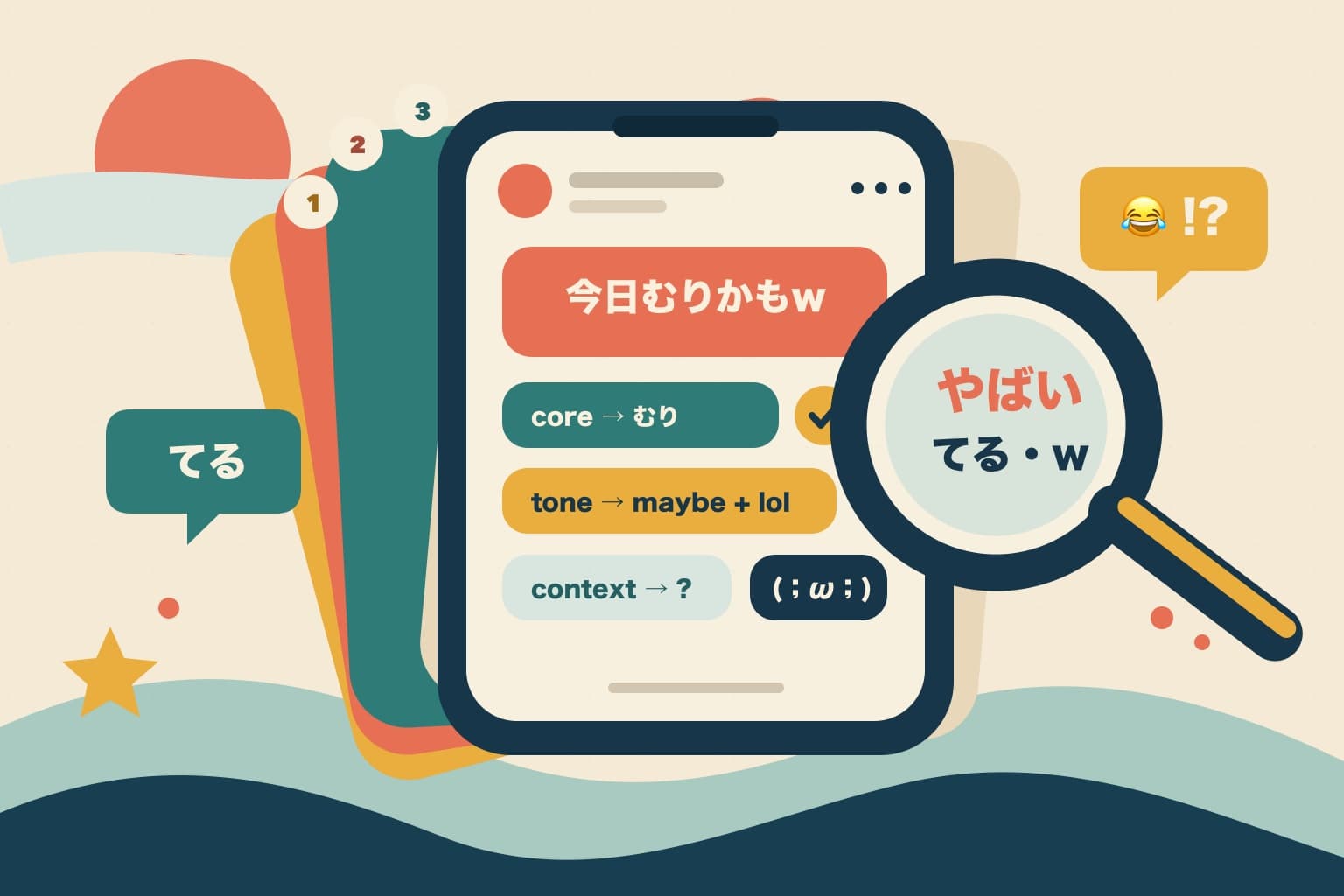
The hardest part of reading Japanese online is rarely one unknown word. It is everything happening at once: a subject disappears, a grammar pattern contracts, a familiar word turns slangy, and one emoji changes the mood of the whole sentence.
The way through is to read in layers. First find the sentence core. Then expand contractions, mark casual expressions, read the visual tone, and finally restore only the context the writer left unstated. That method works whether the text came from Threads, X, YouTube, LINE, or a group chat.
Why real Japanese online feels different
Textbook sentences are built to be self-contained. A social post is built for people who already know the situation.
A textbook might give you:
私は今日は仕事に行くことができません。
“I cannot go to work today.”
A message to a friend might be:
今日むりかもw
“Today might be impossible lol.”
The short version leaves out the subject, the destination, and even the exact reason. むり carries most of the meaning, かも softens it to “maybe,” and w tells you not to hear the line as a formal announcement. Nothing is ungrammatical. The writer is simply relying on shared context.
Five things create most of this gap:
- Omission: subjects, objects, and obvious verbs disappear.
- Compression: forms such as ている become てる.
- Casual vocabulary: words such as やばい or しんどい carry context-dependent tone.
- Sentence endings: ね, よ, じゃん, かも, and って shape the speaker's stance.
- Visual tone: punctuation, emoji, 顔文字, and repeated characters act like body language.
You do not need to solve all five at once. Read them in order.
A five-layer method for decoding a post
1. Find the sentence core
Ignore decoration first. Look for the final verb, adjective, or noun phrase and ask the smallest possible question: what is being said about what?
Take this message:
その映画、気になってたけどまだ見てない😂
The core is 見てない — “haven't watched.” The topic is その映画 — “that film.” Everything else refines the relationship between them.
A useful first pass is:
その映画 → まだ見てない
“That film → haven't watched it yet.”
Do not force a complete English sentence too early. First expose the Japanese structure.
2. Expand contractions
Online Japanese often hides familiar grammar inside a shorter sound:
- 気になってた → 気になっていた
- 見てない → 見ていない
- 食べちゃった → 食べてしまった
- やっとく → やっておく
Once expanded, the film message becomes much more textbook-like:
その映画、気になっていたけどまだ見ていない。
Now the pieces are visible: “I had been interested in that film, but I still haven't watched it.” Our guide to Japanese contractions covers the common forms and the meaning each full form contributes.
3. Mark slang and sentence endings
Next circle the parts that carry attitude rather than basic facts.
今日のライブ、やばすぎたんだけど!
The event is 今日のライブ. The evaluation is やばすぎた — literally built from やばい plus “too much,” but here it probably means the show was unbelievably good. The ending んだけど does not always introduce a spoken “but.” In a reaction like this, it can leave the feeling hanging for the listener to share: “That show today was just unreal!”
This is why replacing every slang word with one English definition fails. やばい can praise, warn, panic, or complain. Our Japanese internet slang guide is a starting map, but the surrounding sentence decides the destination.
4. Read the visual tone
Now put the punctuation and reactions back.
Compare:
- 了解。 — “Understood.” Plain and potentially clipped.
- 了解! — Brighter and more energetic.
- 了解😂 — The writer is laughing about the situation.
- 了解(`・ω・´)ゞ — Playfully ready for duty.
The words barely change. The social meaning does.
Treat emoji and 顔文字 as tone evidence, not dictionary entries. They can suggest warmth, embarrassment, exaggeration, or irony, but they do not erase the context around them. The Japanese kaomoji and emoji guide shows the common patterns without turning them into rigid translations.
5. Restore only the missing context you need
Japanese lets obvious information stay unspoken. English often forces us to add it back.
もう食べた?
Depending on the conversation, a natural translation could be “Have you eaten yet?”, “Did you eat it already?”, or “Have you had dinner?” The Japanese sentence does not specify the subject or object. A good translation restores what the situation requires and no more.
When the context is missing, keep alternatives open. “Have you eaten yet?” is safer than inventing “Did you eat the ramen I bought you?”
A real Threads post, read in layers
This one-line question looks dense at first:
NARUTOに出てくる技で、1つだけできるようになるとしたら何がいい?🔥
Start with the core:
何がいい? — “What would be good?” / “Which would you choose?”
Then attach the surrounding pieces:
- NARUTOに出てくる技 — “techniques that appear in NARUTO.” The phrase before 技 describes it.
- 1つだけ — “only one.”
- できるようになる — “become able to do.”
- としたら — “if we suppose that…”
- 🔥 — adds excitement; it is not part of the grammar.
Put together naturally:
“Of all the techniques in NARUTO, if you could learn to do just one, which would you choose?”
The full NARUTO Threads breakdown follows the replies too, where one short question opens into relative clauses, ability, hypotheticals, and casual hearsay.
Choose the right deep dive
Once you know which layer blocked you, you can study the specific problem instead of vaguely “studying more Japanese.”
- The grammar looks shortened: start with てる, ちゃう, and とく.
- A reaction word has no stable translation: use the internet slang guide.
- A sound or feeling word carries the sentence: see the Japanese onomatopoeia guide.
- The face, emoji, or punctuation changes the mood: use the kaomoji and emoji guide.
- You want a complete post breakdown: read the Threads posts about anime recommendations, a cancelled fireworks plan, NARUTO techniques, or sharing Japanese culture.
That is the real advantage of reading posts instead of isolated flashcards: every sentence shows grammar, vocabulary, register, and culture working together.
Three traps that make posts harder than they are
Translating from the first word forward
A Japanese sentence often saves its main decision for the end. If you lock in an English translation after the first phrase, every later piece feels like a correction. Find the final predicate first, attach the phrases that clearly modify it, and only then write natural English.
Taking the first dictionary meaning
A dictionary can tell you that やばい means “dangerous,” きつい means “tight,” or 重い means “heavy.” A post may use them for “amazing,” “rough,” or “emotionally intense.” Keep the basic meaning in view, but test it against the situation, grammar, and replies before choosing the English word.
Treating casual writing as careless writing
Dropped particles, fragments, repeated punctuation, and compressed forms can look like mistakes because textbooks avoid them. Sometimes a post really does contain a typo. More often, it is following the economy of a fast conversation. Expand what you recognize before deciding the writer broke a rule.
The goal is not to normalize every post into formal Japanese. It is to understand why this short, casual version works for these people in this moment.
A checklist for the next unfamiliar post
When a post feels impossible, use this order:
- Find the final verb, adjective, or noun phrase.
- Identify what topic or phrase it comments on.
- Expand shortened grammar into forms you recognize.
- Mark slang and sentence endings without translating them yet.
- Read punctuation, emoji, and 顔文字 as tone clues.
- Add back only the context needed for natural English.
- Check your reading against the whole conversation, not one word.
If step three fixes the sentence, you had a grammar problem. If step five changes the meaning, you had a tone problem. Knowing which problem you have is already half the answer.
Frequently asked questions
Do I need advanced Japanese to read social media?
No. Many posts use basic grammar, but they compress it and rely heavily on context. A learner around N4 can read a surprising amount once common contractions and casual endings stop looking like new grammar.
Should I translate every omitted subject?
Only when English needs one. Japanese readers infer subjects from context, and sometimes the most honest translation keeps “I,” “you,” or “they” uncertain until more context appears.
Is anime Japanese the same as social-media Japanese?
They overlap in contractions, slang, and sentence endings, but anime dialogue is written performance. Social posts are messy in a different way: typos, fragments, private context, and reactions from other users all matter.
Turn the next post into a lesson
Try the method on this sentence:
今日ほんとにしんどい(;ω;) もう寝るw
Find the core, mark the tone, then paste it into Shiritai to compare the natural translation, literal structure, grammar, vocabulary, and nuance in one place.