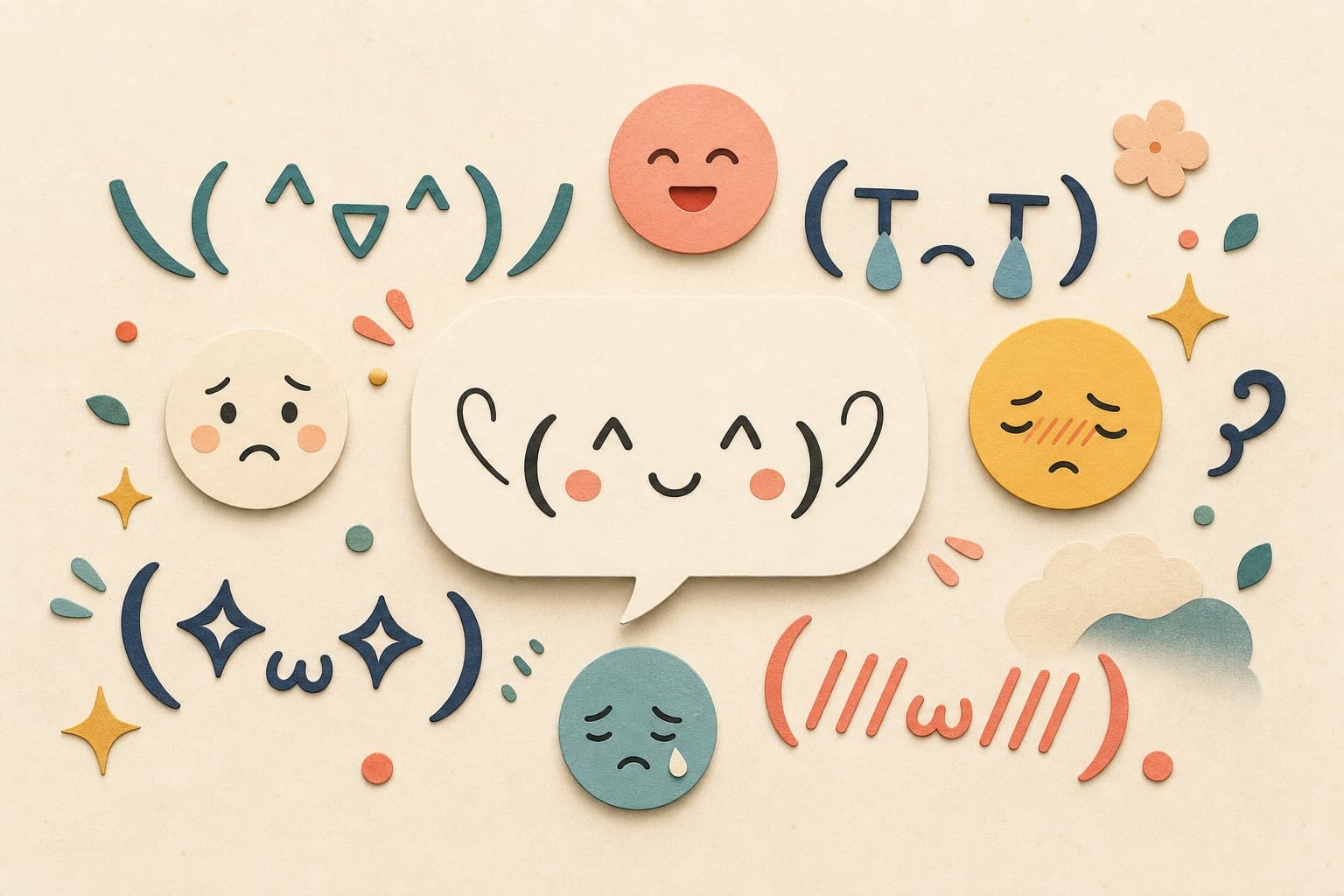
顔文字(かおもじ) are faces built from text characters, such as (;ω;) or ヽ(・∀・)ノ. Emoji are encoded pictographs such as 😂 or 🙏. Both add the tone that a short Japanese message may leave unstated, but they are clues rather than fixed translations.
The safest way to read them is to ask what changed: did the message become warmer, more embarrassed, more exaggerated, or more playful? Read the words first, then use the reaction to adjust the voice.
Quick Japanese kaomoji meanings
| Reaction | Common feeling | Example use |
| --- | --- | --- |
| ( ´ ▽ ` )ノ | cheerful greeting | おはよう!( ´ ▽ ` )ノ |
| ヽ(・∀・)ノ | excitement or celebration | やったー!ヽ(・∀・)ノ |
| (;ω;) | sadness, frustration, or being moved | 終わっちゃった(;ω;) |
| (>_<) | pain, embarrassment, or “this is hard” | また間違えた(><) |
| Σ(゚Д゚) | shock or disbelief | えっ、ほんと?Σ(゚Д゚) |
| (`・ω・´)ゞ | playful determination or “understood!” | 了解です(`・ω・´)ゞ |
| m(_ _)m | bowing: apology, thanks, or request | 遅れてすみません m( _)m |
| (´・ω・`) | disappointment or feeling deflated | 売り切れだった(´・ω・`) |
These meanings are deliberately broad. (;ω;) can mark real sadness, mock despair, or being emotionally overwhelmed. The sentence and relationship decide which one fits.
顔文字 and emoji are not the same thing
A 顔文字 is assembled from text: punctuation, kana, Latin characters, and other symbols become eyes, a mouth, arms, or movement. You usually read it upright.
Emoji such as 😂, 😭, and 🙏 are pictographs represented as encoded characters. Their appearance can vary by platform even though the underlying character is standardized. Unicode documents that system in its official Emoji specification and emoji charts.
In actual messages, the two can do similar work:
- ありがとう!😊
- ありがとう!( ´ ▽ ` )
Both can make “thank you” feel warmer. The second is not simply a text replacement for 😊, though. It has its own style, and a different face can make the same words shy, dramatic, or playful.
Happiness and excitement
Open, raised, or moving “arms” often make a face feel energetic:
ヽ(・∀・)ノ— cheering or celebrating\(^o^)/— big celebration or relief( ´ ▽ ` )ノ— a friendly wave(≧▽≦)— delighted excitement
Examples:
- チケット取れた!\(^o^)/ — “I got the tickets!”
- 今日会えるね(≧▽≦) — “We get to see each other today!”
- おはよう!( ´ ▽ ` )ノ — “Morning!”
Do not translate the face as a separate sentence. Let it color the line: “I got the tickets!” is enough, but the kaomoji tells you to hear a celebration rather than a flat update.
Embarrassment, apology, and bowing
Some reactions soften a mistake or show that the writer knows they are asking something of you:
m(_ _)m— a person bowing(_ _)— a simpler bow(*/ω\*)— hiding the face in embarrassment(〃▽〃)— blushing or shy happiness
Examples:
- 返信遅くなってごめん m(_ _)m — “Sorry my reply took so long.”
- またお願いしてもいい?(_ _) — “Can I ask you again?”
- 褒めすぎだよ(〃▽〃) — “You're praising me too much.”
A bowing face can support an apology, a request, or thanks. It does not automatically make a casual message formally polite. The words still carry the register.
Sadness and frustration
Tears can be sincere, exaggerated, or affectionate:
(;ω;)— crying or deeply moved(T_T)— straightforward tears(>_<)— discomfort, frustration, or embarrassment(´・ω・`)— disappointment or deflation
Compare:
- ライブ終わった。 — “The show ended.”
- ライブ終わった(;ω;) — “The show is over…” with sadness or emotion.
- ライブ終わった😭😭😭 — much more visibly dramatic.
Repeated reactions usually increase intensity, but not mathematical precision. Three crying faces do not mean exactly three times sadder. They show performance and emphasis.
Surprise, confusion, and disbelief
Wide eyes and disrupted shapes often signal a sudden reaction:
Σ(゚Д゚)— shock(・・?)— confusion or a question(°ロ°)— surpriseえ?/えっ— the words themselves may do most of the work
Examples:
- もう全部売り切れ?Σ(゚Д゚) — “It's already completely sold out?!”
- これどういう意味?(・・?) — “What does this mean?”
The kaomoji reinforces the reaction already present in ?, え, or どういう意味. Read those words before deciding how dramatic the face is.
Japanese text reactions: 笑, w, 草, 泣, and 汗
Japanese messages also use characters like stage directions. They sit after a phrase and tell you how to hear it.
笑 and w
笑 marks laughter. w is another laughter marker and can be repeated for stronger or more visible laughter.
- それは無理でしょ笑 — “There's no way lol.”
- また寝坊したw — “I overslept again lol.”
- 何してるのwww — “What are you doing? hahaha.”
草
Rows of w resemble grass, so 草 became another laughter reaction. It can stand alone as a reply or follow a comment.
- その写真は草 — “That photo is hilarious.”
- 草生える — literally “grass grows,” used like “I'm dying laughing.”
The Japanese internet slang guide explains these alongside やばい, しんどい, and other words whose tone depends on context.
泣 and 汗
泣 labels crying, while 汗 can mark awkwardness, pressure, or an “I'm sweating” reaction.
- 当選しなかった(泣)— “I didn't win the lottery (crying).”
- 締切今日だった(汗)— “The deadline was today (sweat).”
Parentheses make them look like an aside, but punctuation varies. You may also see the bare character or an emoji doing the same job.
How punctuation changes the tone
A short reply can move from neutral to playful without changing its basic information:
- 了解です。 — neutral “Understood.”
- 了解です! — brighter and more energetic.
- 了解です😊 — warm and friendly.
- 了解です(`・ω・´)ゞ — playfully ready for the mission.
- 了解ですwww — laughing; only natural if the situation is already funny.
Context still wins. In a professional exchange, 承知しました may fit better than 了解です, and adding a playful face can be inappropriate even if you understand it perfectly.
The same principle applies across real Japanese online: punctuation and reactions are one layer, not a replacement for grammar, vocabulary, or relationship. Contractions shorten the grammar, onomatopoeia carries the feeling, and the face sets the tone — read them together instead of treating any one as the whole message.
When not to copy a reaction
Recognizing a kaomoji is easier than using it naturally. Before copying one, check three things:
- Relationship: a close friend gives you more room than a manager or new client.
- Emotional weight: a playful crying face can feel wrong after genuinely serious news.
- Your normal voice: suddenly using a huge decorative reaction in every line can sound imitated rather than natural.
You never need 顔文字 to write good Japanese. Plain words plus one well-chosen mark often sound more natural than decorating every sentence.
Natural message comparisons
A small mistake
- また間違えた。 — “I made a mistake again.”
- また間違えた(>_<) — embarrassed or frustrated with yourself.
- また間違えたwww — laughing at your repeated mistake.
A plan worked out
- 予約できた。 — “I made the reservation.”
- 予約できた! — pleased and energetic.
- 予約できたー!ヽ(・∀・)ノ — openly celebrating.
A disappointing result
- 売り切れだった。 — “It was sold out.”
- 売り切れだった(´・ω・`) — visibly disappointed.
- 売り切れだった😭 — stronger, more dramatic disappointment.
This comparison is more useful than memorizing “one symbol equals one English word.” The reaction changes how the sentence lands, not what every word literally means.
Frequently asked questions
What does ^^ mean in Japanese texting?
It often looks like smiling eyes and can make a message feel light or friendly. It is not exclusively Japanese, and its tone still depends on the surrounding message.
What does m(_ _)m mean?
It represents a person bowing. Writers use it with apologies, thanks, and requests, usually in casual online communication. The words around it determine which meaning is active.
Are Japanese kaomoji childish?
Not automatically. Some are cute or deliberately dramatic, while simple faces appear in ordinary casual messages. Formality and personal style matter more than a universal age rule.
Read the message, then read the face
Try this one:
今日ほんとにしんどい(;ω;) もう寝るw
The crying face makes the exhaustion visible; the final w adds self-aware laughter. Read the words and reactions together, then paste the message into Shiritai to see how grammar, vocabulary, and tone combine.