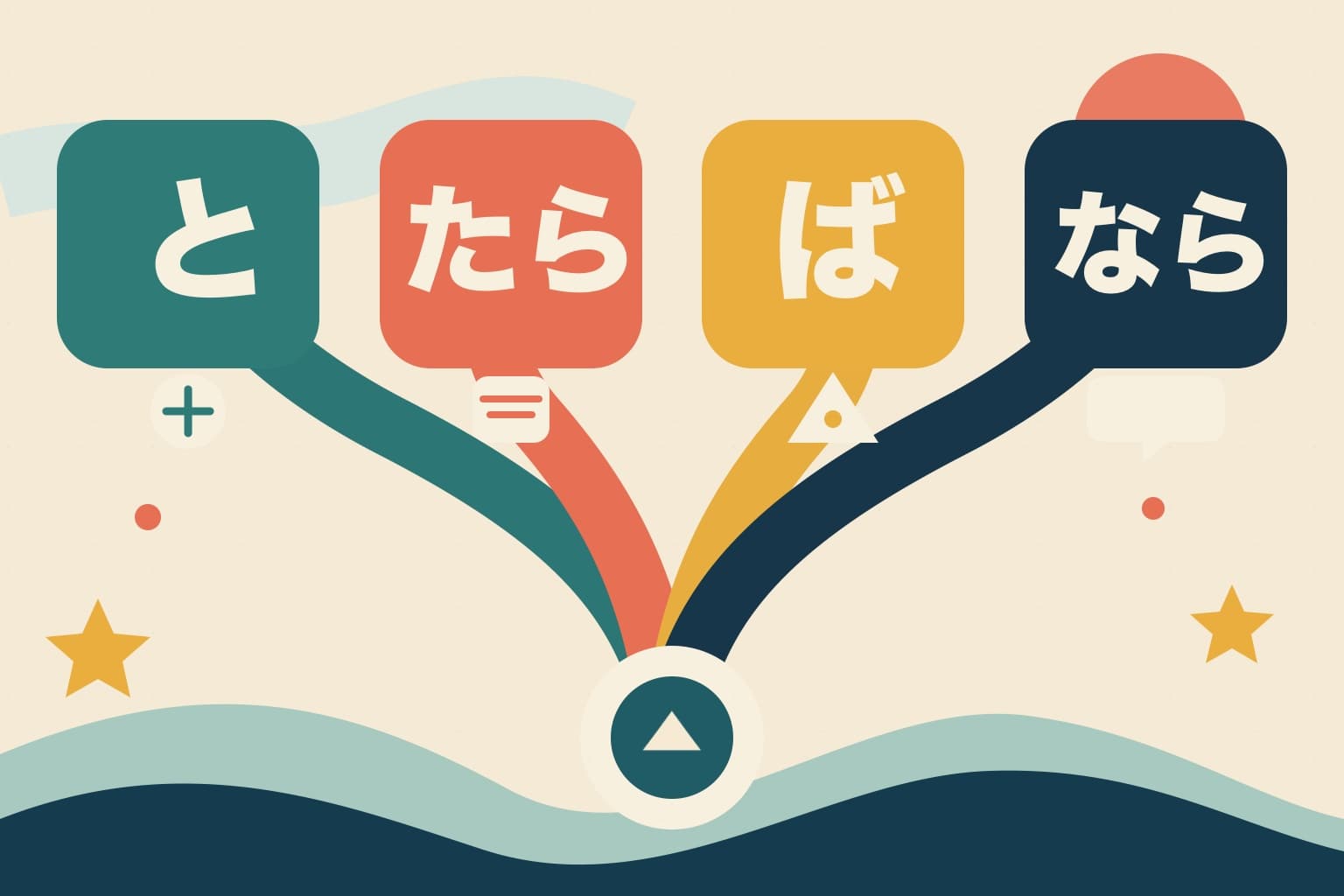
At one point I had four flashcards that all said “if” on the English side: と, たら, ば, and なら. Technically correct. Completely unhelpful.
For a while, I solved this by using たら for almost everything. That isn't the worst survival strategy — たら is wonderfully flexible — but it didn't help me understand why native sentences kept choosing the other three.
What finally made the difference was to stop searching for four separate English translations. The choice is about how the speaker sees the condition: automatic, sequential, logical, or based on something already mentioned.
The short version
| Form | The feeling | Where it fits | | --- | --- | --- | | と | “whenever X happens, Y follows” | facts, habits, directions, automatic results | | たら | “if/when X happens, then…” | one-off events, plans, broad hypotheticals | | ば | “provided X is true…” | logical conditions, advice, general hypotheticals | | なら | “if that's the case…” | reacting to a plan, fact, or assumption |
When I freeze in a casual conversation, I still reach for たら first. But the distinctions below make reading much less guessy.
と: when one thing naturally leads to another
Attach と to the plain non-past form:
- verb: 押(お)すと → “when/if (you) press”
- い-adjective: 安(やす)いと → “if it is cheap”
- noun / な-adjective: 静(しず)かだと → “if it is quiet”
と fits when the result feels automatic, repeated, or simply how the world works.
- 春(はる)になると、桜(さくら)が咲(さ)く。 → “When spring comes, cherry blossoms bloom.”
- このボタンを押すと、ドアが開(あ)く。 → “When you press this button, the door opens.”
- 夜(よる)になると、眠(ねむ)くなる。 → “When night comes, I get sleepy.”
You'll also see it in directions. The speaker isn't deciding what happens next; they're describing the route:
- 右(みぎ)に曲(ま)がると、駅(えき)があります。 → “Turn right and you’ll find the station.”
Why と sounds wrong before a request
With a future condition, と usually doesn't lead into a command, invitation, request, or personal decision. Those outcomes aren't automatic.
- ❌ 駅に着(つ)くと、電話(でんわ)してください。
- ✅ 駅に着いたら、電話してください。 → “When you arrive at the station, please call.”
The call is something you're asking the listener to do, so たら fits much better.
たら: the everyday all-rounder
To make たら, take the plain past form and add ら:
- 食(た)べる → 食べた → 食べたら
- 行(い)く → 行った → 行ったら
- 安い → 安かった → 安かったら
- 静かだ → 静かだった → 静かだったら
- 学生(がくせい)だ → 学生だった → 学生だったら
It looks like a past form, which confused me at first, but it can point straight into the future. The idea is “once this condition is met, then…”
- 雨(あめ)が降(ふ)ったら、家(いえ)にいる。 → “If it rains, I’ll stay home.”
- 東京(とうきょう)に行ったら、何(なに)がしたい? → “If you go to Tokyo, what do you want to do?”
- 仕事が終(お)わったら、連絡(れんらく)して。 → “Contact me when work is finished.”
たら is comfortable with things と tends to reject: requests, plans, invitations, and one-off situations.
- 暇(ひま)だったら、一緒(いっしょ)に行こう。 → “If you’re free, let’s go together.”
- 分(わ)からなかったら、聞(き)いてください。 → “If you don’t understand, please ask.”
If 食べた and 行った still feel unpredictable, our Japanese て-form guide can help. The た-form and て-form use the same sound changes, so learning one makes the other much less painful.
ば: putting the condition under a spotlight
ば was the last one to click for me. It often feels more logical than たら: provided this condition holds, the result can follow. You'll meet it in general statements, advice, and slightly more written-sounding Japanese.
The formation takes some practice. For う-verbs, move the final kana from the う-row to the え-row, then add ば:
- 書(か)く → 書けば
- 読(よ)む → 読めば
- 話(はな)す → 話せば
For る-verbs, replace る with れば:
- 食べる → 食べれば
- 見(み)る → 見れば
The other forms you'll need most often are:
- い-adjective: 安い → 安ければ
- negative: 行かない → 行かなければ
- noun / な-adjective: 学生なら / 学生であれば、静かなら / 静かであれば
- する → すれば
- 来(く)る → 来(く)れば
In sentences:
- 時間(じかん)があれば、手伝(てつだ)います。 → “If I have time, I’ll help.”
- もっと安ければ、買(か)う。 → “If it were cheaper, I’d buy it.”
- 毎日(まいにち)読めば、少(すこ)しずつ速(はや)くなる。 → “If you read every day, you’ll gradually get faster.”
- よければ、どうぞ。 → “If you’d like, go ahead.”
That last one hides a common trap: いい becomes よければ, never いいば.
と and ば can describe the same button
Compare these:
- ボタンを押すと、ドアが開く。
- ボタンを押せば、ドアが開く。
Both can mean “If you press the button, the door opens.” With と, I picture the automatic sequence: press, click, open. With ば, pressing is the condition that needs to be met.
This is also where the grammar gets a little fussy. When the first clause is a deliberate action and the same person controls the second clause, ば can sound awkward with invitations or intentions. For a one-time plan, たら is usually more natural:
- ? 東京に行けば、友達に会おう。
- ✅ 東京に行ったら、友達に会おう。 → “When I go to Tokyo, I’ll meet my friend.”
If the condition is a state rather than an action you're choosing, a suggestion is fine:
- 暇なら / 暇であれば、一緒に行こう。 → “If you’re free, let’s go together.”
You don't need to solve every edge case while speaking. Recognizing the logical flavor of ば is already a big step.
なら: picking up what someone just said
なら often reacts to information already in the conversation. Someone mentions a plan or possibility, and you respond: “If that's the case…”
- noun: 学生なら → “if (you) are a student”
- な-adjective: 静かなら → “if it is quiet”
- verb: 行くなら → “if (you) are going”
- い-adjective: 安いなら → “if it is cheap”
A short exchange makes the feeling clearer:
- A: 北海道(ほっかいどう)に行きたい。 → “I want to go to Hokkaido.”
- B: 北海道に行くなら、冬(ふゆ)の服(ふく)を持(も)っていって。 → “If you’re going to Hokkaido, take winter clothes.”
Or:
- A: 新(あたら)しいスマホが欲しい。 → “I want a new phone.”
- B: 買うなら、この店が安いよ。 → “If you’re going to buy one, this shop is cheap.”
The useful wrinkle is timing. You need to pack the clothes before going to Hokkaido. なら works because it responds to the plan; it doesn't mean “after you go.” That's one of the clearest differences from たら.
You'll also meet ならば and であるなら in formal writing or dramatic speech. Same family, fancier clothes.
One trip, four different viewpoints
Here's the comparison I wish my flashcards had shown me:
- 日本(にほん)に行くと、日本語を使う機会(きかい)が増(ふ)える。 → “When you go to Japan, opportunities to use Japanese increase.” A natural result.
- 日本に行ったら、京都(きょうと)にも行きたい。 → “When I go to Japan, I want to visit Kyoto too.” A future sequence and personal plan.
- 日本に行けば、日本語が上手(じょうず)になるとは限(かぎ)らない。 → “Going to Japan does not necessarily mean your Japanese will improve.” A condition being considered logically.
- 日本に行くなら、春がおすすめ。 → “If you’re going to Japan, I recommend spring.” Advice based on someone's plan.
The event barely changes. The camera angle does.
How I choose when I get stuck
I run through four quick questions:
- Does Y happen automatically or repeatedly after X? Try と.
- Do I mean “if/when X happens,” especially with a plan or request? Try たら.
- Am I presenting X as the condition needed for Y? Try ば.
- Am I reacting to a fact, assumption, or plan? Try なら.
These aren't sealed boxes. Native speakers can frame the same event differently, which is why two conditionals may both be grammatical without feeling identical.
Mistakes worth catching early
- Putting と before a request. For “when you arrive, call me,” use 着いたら rather than 着くと.
- Assuming たら must describe the past. 明日雨が降ったら is a future condition: “if it rains tomorrow.”
- Building ば from the wrong stem. 読む becomes 読めば, not 読みば.
- Forgetting the irregular いい form. It's よければ.
- Reading なら as a time sequence. It reacts to a premise, and the advice may need to happen before the planned event.
- Trying to assign one English word to each form. English “if” and “when” divide these ideas differently.
Are Japanese conditionals on the JLPT?
The basic uses of と and たら appear early. Comparing と・たら・ば・なら is core JLPT N4 territory, and later questions get pickier about context and restrictions. If your N5 foundations need a check, start with the JLPT N5 grammar checklist, then practice conditionals inside full sentences rather than as four isolated flashcards.
The takeaway
Think と for a result that naturally follows, たら for the flexible everyday “if/when,” ば for a condition under consideration, and なら for “if that's the case.” You won't choose perfectly every time. I don't either. But once you listen for the speaker's viewpoint, the four forms stop looking like duplicate vocabulary.
When a real post uses a conditional you weren't expecting, paste the sentence into Shiritai and compare the grammar with the surrounding context. That's usually where the choice starts to make sense.